
Dental student · Scored well on the DAT and earned admission to dental school
Last updated: September 2026
Quick answer: The Perceptual Ability Test (PAT) is the DAT’s 90-question, 60-minute spatial reasoning section. It has six question types: keyholes, top-front-end views, angle ranking, hole punching, cube counting and pattern folding (ADA).
PAT at a glance
| Detail | PAT |
|---|---|
| Questions | 90 (six question types) |
| Time | 60 minutes (about 40 seconds per question) |
| Question types | Keyholes, top-front-end, angle ranking, hole punching, cube counting, pattern folding |
| Counts toward the Academic Average? | No. The PAT is reported separately |
Source: ADA.
Are you planning to pursue a career in dentistry and don’t know how to ace various tests involved in that profession? PAT (Perceptual Ability Test) is one part of the Dental Admission Test (DAT) exam that is considered the most challenging. It involves measuring your capacity to manipulate and understand two-dimensional representations of three-dimensional objects. This is a crucial skill for dentists that must work on complex dental structures. While preparing for PAT can be a daunting task, this article will take you through this process and give you tips on how to ace the exam effortlessly.
Reviewer’s takeaway — Bryant C. (Dental student · Scored well on the DAT and earned admission to dental school)
For pattern folding, predict the finished shape before watching a 3D explanation. Compare your reasoning with the animation, then try another question without the visual aid.
How should you prepare for the DAT PAT?
Prepare for the Dental Admission Test (DAT) Perceptual Ability Test (PAT) by learning the question formats, practicing spatial problems, and reviewing your mistakes.
- Learn the formats: Understand what each question type is asking before you try to answer it.
- Practice your weaker question types: Spend extra time on whichever subtests give you the most trouble.
- Review incorrect answers: Figure out why you missed a question before repeating a practice set.
- Include timed practice: Work on accuracy and time management together, not separately.
What is The Perceptual Ability Test?
PAT is a section of DAT used by dental schools to evaluate a candidate’s reasoning and visual-spatial abilities. The skills gained from this test help dentists to work on intricate dental structures by understanding the spatial relationships between bones, teeth, and other structures in the mouth.
Good scores in PAT enable students to be admitted to dental school. Many dental schools use this as a gauge in making admission decisions. As such, it is a critical element that must not be underrated by any person that wants to pursue dentistry.
PAT test consists of 90 questions that must be done within 60 minutes. The test assesses aptitude in the following areas.
- Keyholes
- Top-Front-End
- Angle Ranking
- Hole Punching
- Cube counting
- Pattern Folding
Keyholes
This area assesses the ability of a candidate to understand visual information by manipulating 3D shapes mentally. It consists of a series of images of keyholes with various sizes and shapes, and the candidate is asked to determine which 3D object will fit through the keyhole. The object can be turned in any direction before it’s inserted — the rule is that it can’t be flipped or rotated once it starts going through the opening.
Keyholes require a candidate to have mental rotation abilities and spatial reasoning. These skills are applicable in dentistry since they enable a dentist to visualize the orientation of instruments in a patient’s mouth for accurate procedures such as tooth extraction.
You can check this example from DAT Bootcamp.
Top-Front-End
In Top-Front-End (TFE) questions, you’re shown two of the three standard 2D views of a 3D object — the top view (looking down from above), the front view (looking straight ahead), and the end view (looking from the side) — and asked to identify the correct missing third view from the answer choices.
This tests spatial visualization and mental rotation: you have to mentally build the 3D object from the two views you’re given, then figure out how it would look from the missing angle. Part of the challenge is reading technical drawing conventions correctly — solid lines represent edges you can directly see, while dotted lines represent hidden edges or internal features from that viewing angle.
Most students find TFE one of the harder PAT subtests to get comfortable with at first. Rather than trying to visualize the entire object in one go, it helps to work through the answer choices systematically — eliminating options one feature at a time.
Angle Ranking
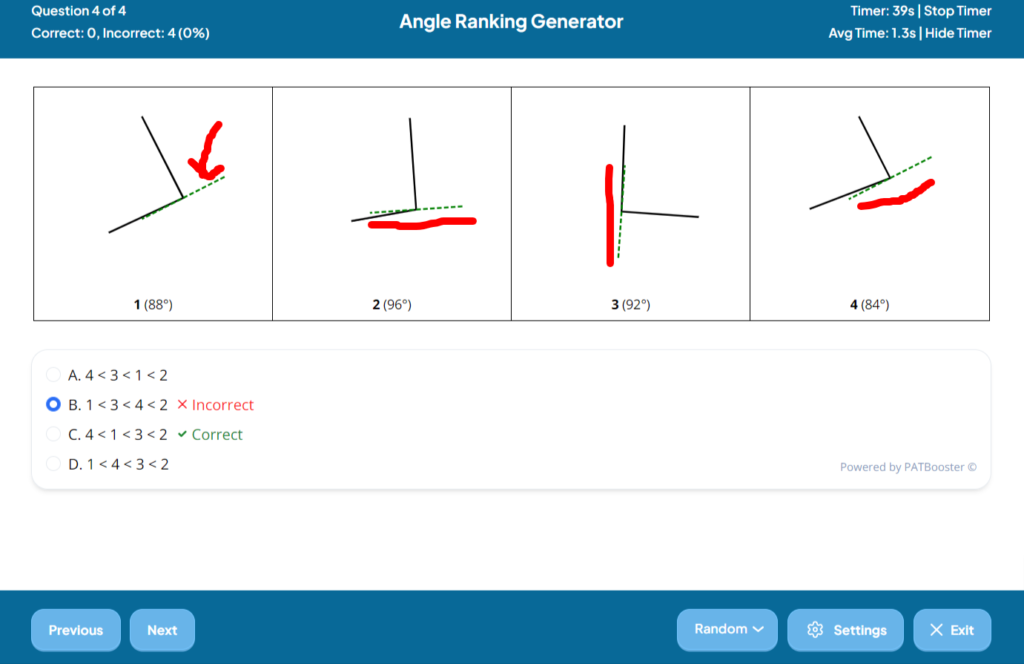
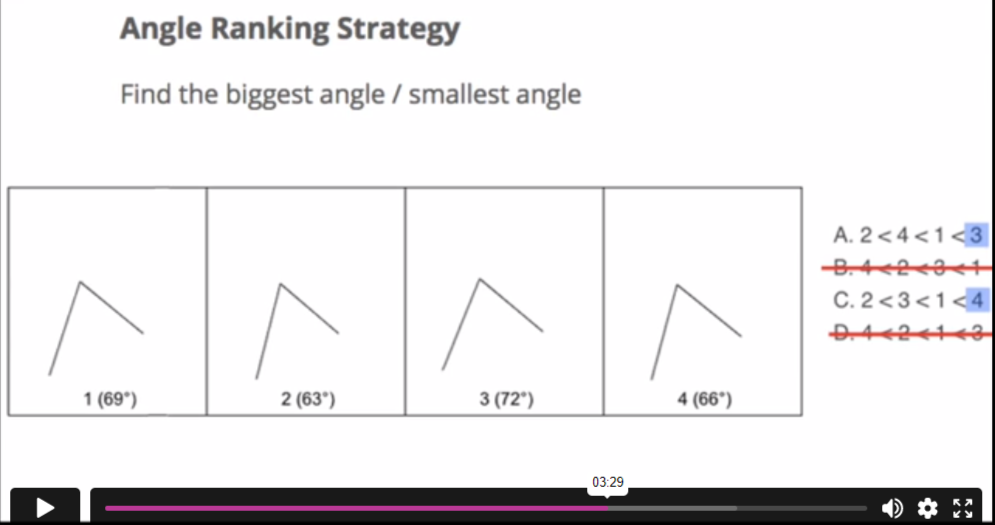
This area requires a candidate to identify and compare the size of angles. Gaining the skill enables a dentist to evaluate and diagnose dental conditions. For instance, dentists usually use angles to evaluate the position of the jaw and the alignment of teeth.
The most common method of testing in this area is where a candidate is presented with various angles and asked to rank them in order of size. The angles themselves are two-dimensional — the challenge is that they’re shown at different rotations, which makes it harder to compare their size at a glance.
The easiest way to grasp and understand the angles is through visualization exercises such as drawing or sketching angles from different perspectives. A candidate can also try observing the angles in various objects and structures around a building or a particular piece of furniture.
Hole Punching
Hole punching assesses reasoning skills, perceptual ability, and spatial visualization. You’re shown a square of paper that’s been folded one or more times, with a hole punched through it after the last fold. The task is to mentally unfold the paper and figure out where the holes end up on the original, flat square.
This exercise requires a candidate to have geometrical skills such as congruence, symmetry, and transformation to be able to mentally manipulate two-dimensional shapes and visualize three-dimensional counterparts.
The best way to master this skill is to practice drawing the shape and folding paper along different axes to see how the shape changes.
Cube counting
In the area of cube counting, a candidate is presented with various two-dimensional images of cubes that are arranged in different orientations. Picture the stack in three dimensions, then count the cubes with the number of painted faces asked for in the question. Track the cubes systematically so you do not count one twice.
To do well in the cube counting section, you need to have a strong background in geometrical concepts such as symmetry, shapes, and spatial relationships. You need to practice this skill by drawing three-dimensional shapes and then rotating them in your mind and seeing how they will change.
Pattern Folding
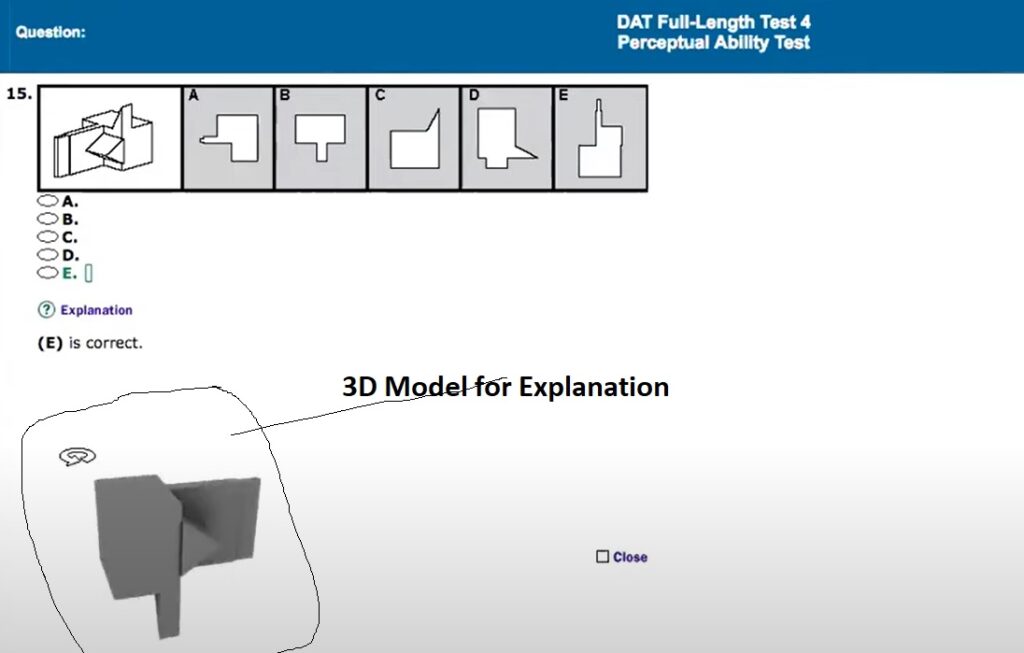
In this area, a candidate is presented with two-dimensional patterns that are folded partially. One is then asked to visualize the paper as if it is completely folded and then choose an answer choice that represents what the pattern could look like.
Pattern folding can use various methods such as color matching, side counting, and shape matching. When it comes to colors, a candidate is asked to match colors that overlap. This works well when there are patterns with distinct gradients and colors.
A candidate can have a good mastery through practicing with different methods and seeing which one works best for them. For instance, one can accurately match shapes while the other may have an easy time counting sides or matching colors. Practicing with different methods will build confidence and improve performance.
Here is a sample example from Bootcamp.
Tips on how to study for the DAT Perceptual Ability Test (PAT)
Here are some tips that you can apply while preparing for PAT to enhance your chances of success.
Understand the format of the test
To prepare well for the PAT test, it is crucial to understand the format of the test. First, you need to familiarize yourself with the different subjects which are used to test different aspects of perceptual ability. The subjects include 2D visualization, 3D visualization, angle ranking, hole punching, pattern folding, and cube counting.
The next thing that you need to pay critical attention to is knowing the number of questions per subject. Each subject contains 15 questions. This knowledge can help you prepare better for the exam by knowing which subject requires more of your attention, or which proves hard to understand.
You will also need to understand the multiple-choice format and chose the best answer from a set of five or four options. Understanding this format will help you avoid confusion and familiarize yourself with tricky options.
You will need to practice the official practice test since they will give you the same format as the actual test. You can visit the ADA website and search for these tests to see the format used.
To get more familiar with the format of the test, consider taking timed practice tests to gauge yourself how much time it will take you. With time, you will get the desired accuracy and speed.
Use study guides
A study guide is a comprehensive tool that covers all concepts and topics that are likely to appear in a test. It provides a structured outlook to studying and helps learners focus on the crucial concepts and stop avoiding wasting time on the less essential topics. A study guide will also help you identify your weaknesses and strengths and help you notice where you need to add more practice.
When using a study guide, you need to start studying early probably some months before the test date to ensure that you cover all the topics in good time. You also need to use a high-quality PAT study guide. This means one that is updated with great online reviews.
Use the study guide to identify your weaknesses and focus your efforts on improving these areas. Practice on these areas until you feel comfortable tackling the main test.
In instances that seem complex use answer explanations on the study guides to gain a detailed explanation of the practice questions. Understand why certain answers are correct or wrong to strengthen your understanding of the concepts.
Watch videos
You might not grasp all the PAT concepts by reading alone. You need to supplement your reading by watching videos. They will allow you to see various approaches to solving problems and provide examples of how to apply this knowledge to real situations.
You need to use reliable resources from reputable educational sources or those created by professionals. While at it, focus on quality and avoid poor-quality videos that may make your understanding difficult.
Also, do not rely on videos from one source. Use a variety to gain more exposure to different teaching perspectives and styles.
When watching these educational videos remember to take notes to reinforce your understanding and memory. Write key points that you will find to be helpful. Solidify your understanding by practicing what you’ve learned in the videos.
Learn from your mistakes
Learning from your mistakes is a crucial part of improving performance on the PAT test. To perform well, you need to analyze your errors by identifying your weak areas. You will notice the type of questions that you struggle with and apply a different approach that will increase your confidence.
Keep a record of the errors and the question numbers, the type of mistake, and the reason why you made the mistake. This record will be essential when tracking your progress over a certain period. You will then identify patterns in your errors and devise efforts of overcoming them.
Time yourself
Timing yourself while practicing PAT is very important since it stimulates the real task-taking environment. As such, you are able to tell how much time you will need to complete each section. You will learn how to manage with yourself and do exactly the same during the actual test. This will reduce the chances of running out of time.
When you learn about time management, you improve your efficiency in answering questions accurately and quickly. You will be able to maximize your score and increase your chances of passing the test.
Time management also helps you get used to performing under pressure. The actual test can make you panic and stress you since you are not used to such engagements. Practicing under timed conditions will help you reduce test anxiety and boost your confidence.
Lastly, timing yourself will help you devise a strategy for answering questions. You will know the amount of time needed to answer each question by figuring out which to answer first and which to answer later.
Get help if you need it
If the process of preparing for the PAT test seems challenging to you, it is advisable to consider getting help. There are different types of help that you can consider but note that each works differently and may or may not favor you. If one doesn’t work out for you, consider using another one. You can join study groups to practice the test or review your notes. Working in discussion groups with others helps you become accountable and motivated while boosting your confidence. You can ask your peer to give you tips and strategies that they use and mimic them. One example of such strategy is using elimination technique to zero on the right answer.
Another way that you can seek help is by searching for online resources. Supplement your studying by searching for answers on online platforms.
If you are struggling to understand PAT concepts, you can consider hiring a tutor in the areas that seem challenging for you. A tutor will give you individualized support and guidance and help you identify the areas that need more effort. The tutor will customize the lesson based on this and ensure you get all the concepts.
For PAT practice generators and full-length tests, compare the programs in our best DAT prep courses guide.
PAT tools are one of the clearest differences between the two most popular DAT courses: DAT Booster includes a keyhole generator, while Bootcamp offers the larger PAT question bank. See how DAT Bootcamp compares with DAT Booster for a side-by-side look.
Frequently Asked Questions
Is the PAT part of the DAT Academic Average?
No. The PAT is scored and reported separately and isn’t included in the Academic Average.
Can you get better at the PAT with practice?
Yes. PAT skills improve noticeably with timed drills, which is why most prep courses include PAT generators.
Editorial note: For pattern folding, try predicting the finished shape before watching a folding animation. Then compare your answer with the animation to see where your visualization went wrong.
A practical PAT routine
Practice a few question types regularly and keep track of recurring mistakes. For pattern folding, predict the result before viewing a 3D explanation. Add timed sets once you can explain how you arrived at an answer.
Final thoughts
Preparing for the Perceptual Ability Test requires a lot of determination coupled with diligent studying, practice, and effective test-taking strategies. By following the guidelines articulated in this article, you can build knowledge and skills that will enable you to ace the test smoothly.
Remember to be consistent in your learning and practice for your efforts to bear fruits. With hard work and determination, you can master the PAT section and achieve your goals of pursuing dentistry as a career. Get started today and increases the chances of your success.